


The summer after eighth grade, I was determined to make a fortune, or at least part of a fortune. I had four years left of fleeting youth to figure out what I wanted and who I I was supposed to be. I didn’t know any of those things. But I possessed a particular type of intense, aimless ambition—the kind where you don’t know what you want, only that you want it desperately. And in the absence of any real direction, I decided that what I wanted was to be rich.
Fourteen was a critical age; it meant that I could legally work and I had been counting down to the days since I was eleven. My parents didn’t think to hold me back a year, like all the other children born between May and September were in my town. These red-shirted children had all the advantages in grade school, with their size and hand-eye coordination that came with being several months older when it mattered; they dominated in the only thing that mattered back then: sports. As we got older, they’d be the first to make money, first to drive, and the first to get caught making out in gas station parking lots.
For all of the counting I did, I ended up last by way of teenage metrics and milestones; likewise, I was the last to turn fourteen, which I did two days after the end of eighth grade.
Two weeks prior, I had begun preparing for this monumental moment. I sat in my history class, filling out my applications on my school computer. Summer was only ten weeks, and between the time taken to process applications and do interviews, half the summer would be over if I didn’t move fast.
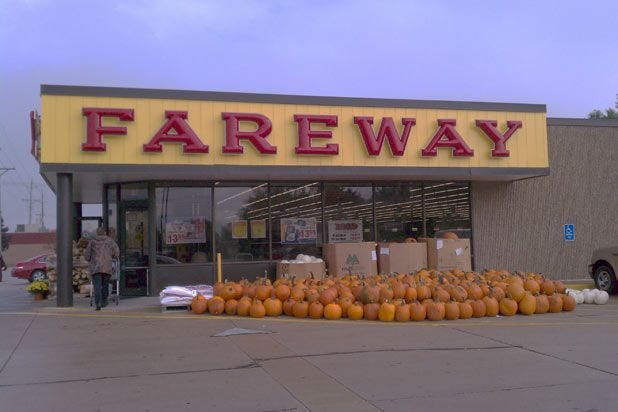
There were only three places in town that hired fourteen-year-olds that year. And my top contender was Fareway, the good American grocery that closed on Sundays and made teenagers wear button-downs and ties and carry your groceries to your trunk, no matter the weather. Whether it was the sweaty summer evening or frigid winter morning, some red-faced kid would follow you to your car with bags you could have easily carried in an unnecessary display of relentless midwestern hospitality.
The business of getting willing bodies, ready to put on white button-downs and slacks on the hottest summer days, was a difficult one—which is why Fareway was known for hiring anyone over the age of fourteen with a pulse and two brain cells. The misery of the job didn’t bother me. For $7.25 an hour and a title, I was willing to be whatever the bossman wanted me to be. And if I needed to be a god-fearing Protestant who carried groceries out to the car with a “thank you, ma’am,” I would be that.
On my way to personally hand in my application, I walked past a sea of single-wide trailers and fast-food chain restaurants, in my slacks and blouse, determined to project and air of sophistication this town sorely lacked. I found the manager and delivered a professional introduction. I waited patiently, with all the poise I could muster, as it took five painful attempts to get the manager to pronounce my name right before she finally said I’d “hear back soon.”
I never did hear back, but a week later, I heard from a friend of a friend that a girl we had deemed to be “dumb as rocks” had strutted into Fareway last week and got hired on the spot. No application. No blouse. No slacks. Nothing but the rocks I imagined rolled around between her ears every time she attempted to form a thought.
Was I so incompetent that I was unfit to bag groceries? What did “dumb as rocks” girl have that I didn’t?
My mom told me I shouldn’t be so hard on myself and that I could probably bag groceries just fine, but that a store known for its good Christian values likely doesn’t want a brown person as the face of their grocery-hauling service.
“Unfair is the world, kid.”
If it was up to me, I would be a blonde, baptist girl with a December birthday, and I’d be the first in all the measures that mattered. For $7.25 an hour, I was willing to put all that aside and work; but the world didn’t seem to be as willing as I was. Yet again, I was stuck behind the rest.
While my Fareway dreams were crushed, there were still two more places left that would hire me. I knew God hadn’t abandoned me yet, when when the country club lady left a voicemail about an interview for an attendant position.
I’d never been inside a country club but watched enough movies to imagine myself raking in tips while rubbing elbows with the wealthy and well-connected. By the time I called back to schedule my interview, I had already developed a detailed fantasy where I would befriend some glamorous old bat whose late husband made a fortune in steel or shipping back east. Probably estranged from her actual children for some regrettable mistakes in the past, but would see the hunger in my eyes and take me under her wing to complete some contrived redemption plot. Maybe leave me something in the will and secure herself a spot at the pearly gates. I imagined myself as a minimum wage brown Cinderella at the country club, scrubbing floors and bussing tables until I charmed my way into something relevant.
However my country-club princess fantasy quickly faded when I realized the club was a fifteen-minute drive from home, which meant I’d need my mom to drive me until I got my school permit. When I told her about the job and my potential to make so much money and definitively alter the course of my life, she yelled at me and my measly ambitions.
“Aishu, why do you dream of serving rich people? You should want to BE rich people. I will not drive you there to be their help.”
This was the rags part of the rags-to-riches story that she could not grasp. Not that we were from any real rags at the time; we were well-to-do ourselves—we just had no business playing golf at the country club. If I someday wanted to be a rich country club asshole paying someone to park my $80,000 car, I had to do my time as the poor asshole parking it. That was the order of the universe, and I was determined to clock in enough hours of servitude to tip the scales as fast as possible. But I couldn’t even get to the interview.
***
Halfway through the summer, the manager at Burger King had finally called me back. My first job interview ever was at Burger King, located in the swankily renovated new-old part of town at 2 pm on a Wednesday. For a new building, it had already devolved into a greasy establishment filled with shady no-good characters. I pushed through the door anyway and greeted the cashier, who appeared to be reasonably stoned.
“I’m here for an interview.”
“A what?”
“An interview. Your manager called me.”
He disappeared into the back to confer with the fry cook, a bright red-haired girl who was equally apathetic to the whole ordeal of me and my interview. After five minutes of back and forth between the two inebriated coworkers, he returned to tell inform me, “Manager’ll be back in thirty minutes. I’ll get you something to drink while you wait.”
So I sipped a cherry Coke and I waited. I imagined myself assembling burgers and filling up fountain drinks behind the counter. The fluorescent lights were doubly unpleasant in the mid-afternoon sunshine. I wasn’t fond of polo’s either, but that’s what all my potential future coworkers wore, so I suppose I’d suck it up when the manager arrived and tell her I loved the uniform if it meant I could get a job. I was willing and able to be the world’s most eager burger girl if that’s what they needed me to be. And this job paid a full $8, almost a dollar over minimum wage. If I nailed this interview, I’d basically be rich.
Thirty minutes became an hour, and the cherry coke was gone. The stoned cashier had forgotten I existed and so had the manager. After ninety minutes of waiting in a greasy fluorescent purgatory, I finally gave up. Soaked with sweat as I trudged home in the wet, hot July heat, defeated yet again.
***
Everyone my age who wanted a job had a job. Everyone else worked because their parents made them work to learn essential life lessons that I already knew—like responsibility and the value of hard work and a dollar. I wasn’t like those other kids who’d just grow up and stay right where they started. I wanted to work and I could work harder than anyone else. Too bad work didn’t want me. The teachers at school were always gushing about my alleged potential, yet not a single establishment in town deemed me fit to handle a cash register.
That summer ended with zero jobs and zero dollars, which meant I would spend the following years making up for my summer of lost income, working doubly hard. I never had to carry groceries or flip burgers, but I’ve been paid to scrub toilets and make PowerPoint presentations. I’ve had twelve jobs by the age of twenty-one. Each came with a name tag or email signature that told me who I was supposed to be. I made a whole lot of money, but I never could shake the flighty ambition I had at fourteen—the ambition that had me desperate for $7.25.
I always believed that the virtuous part of work was how hard it was.That my borderline masochistic ability to brave any circumstance made me better than the rest. By the tenth job, I learned that hard work is actually the easiest thing. Whether it’s eight hours on your feet or six hours in mind-numbing meetings, it’s all the same when it’s followed by exhaustion so complete you can’t think about anything else. Pain and busyness make excellent distractions from yourself.
As I think back to my fourteen-year-old self, I find it silly that I thought I’d get rich making midwestern minimum wage, but I find it more sinister that my only aspiration was to be rich. But I was too young and headstrong to have any other desires. I didn’t know what I liked or who I loved or who I was. All I knew was how to count money. And when you don’t know who you are, the easiest thing is to charge full speed towards the only thing you understand.
As I read this wonderful memoir/essay, I realized it wasn’t that long ago you were 14. As a football fan, I was dumbfounded when I discovered that parents in Texas (and Iowa too) held back their star-potential kids so they would be bigger and stronger to shine under the Friday Night Lights of high school football. The kids who worked at Burger King got left back all on their own. You’ve separated the work ethic from the monetary rewards, so you win the game.